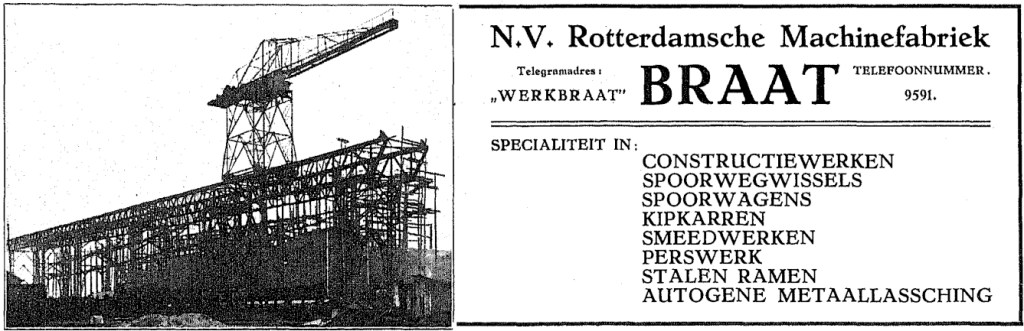
Carel Christiaan (Carl) van den Bosch was born, the second of five children, in Surabaya, Netherlands East Indies, on May 11, 1919, to Jean Baptiste (Jan) and Johanna (Anne). His father was a civil engineer, born in Amsterdam and trained in Delft, who was hired by the engineering and construction firm Braat and sent out to the Indies at a time, just before the First World War, when the group of islands that was to become Indonesia was undergoing development and modernization at a heady pace, an initiative that involved much infrastructure development, such as roads, harbours and railways. In a shipping industry newspaper of May 1919, N.V. Rotterdamsche Machinefabriek Braat advertises its expertise in railway and related steel construction; an image next to one of the two ads shows what appears to be a large dockside crane structure.
In school Carl showed an interest in history and in art, but the Great Depression mandated more practical directions. A hard lesson was learned when, just before the crash, Jan van den Bosch and a colleague leave Braat to start their own engineering firm that, after initial successes, fails when work dries up.
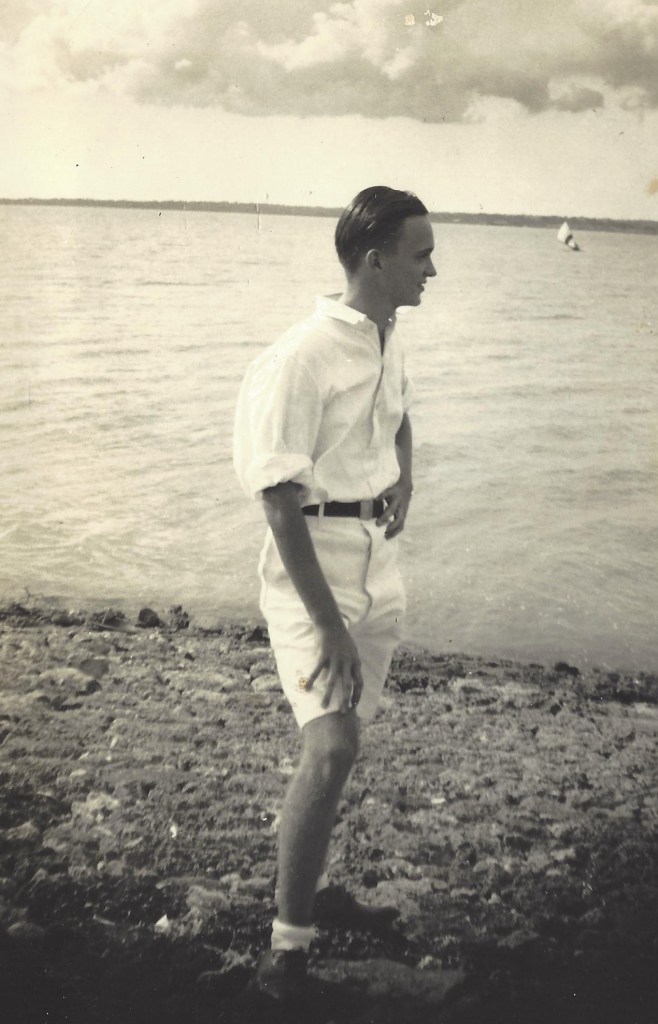
Carl at age 17, in 1936 on the waterfront at Surabaya. Among his abiding interests would be the sea and seafarers.
1939-1941 On completion of high school and compulsory military service Carl became first a junior draftsman in the Vulkaan machine factory in Surabaya and then an employee of the J.A.Wattie Company on their rubber estate at Chondong, West Java. In 1940 his father died of a massive stroke as the two of them commuted by train between work in Surabaya and the cooler uplands of Malang where the family lived. Carl’s older brother, also Jan, had given up medical studies because of the family’s straitened circumstances and was already employed at Wattie. (J.A. Wattie, originally a British company, still exists as an Indonesian company, and it is still largely concentrated on the production of rubber, tea and coffee. It celebrated its centenary in 2021.)
December 1941 – May 1942, Carl and two of his brothers were recalled to active service as Japan invaded much of South-East Asia. Carl was truck driver for the Third Artillery Batallion, first at Camp Tanah Abang, named for a village now absorbed into Jakarta, then at Camp Bodyong Pityong, also in West Java.
May 1942 – September 1945, on capitulation of Netherlands East Indies, Carl was interned as P.O.W. in camps Sukabumi, Tjimahi, and Batavia in West Java; then, after perilous sea-transport, in Changhi Camp at Singapore and from April 1943 at Futuase Camp, Fukuokaken, Kyushu, Japan. Prisoners of war were used as slave labour—in this camp, to work the coal mines.

1982 The Ship Hove To — coloured pencil on paper; image of prisoner transport in a storm at sea. 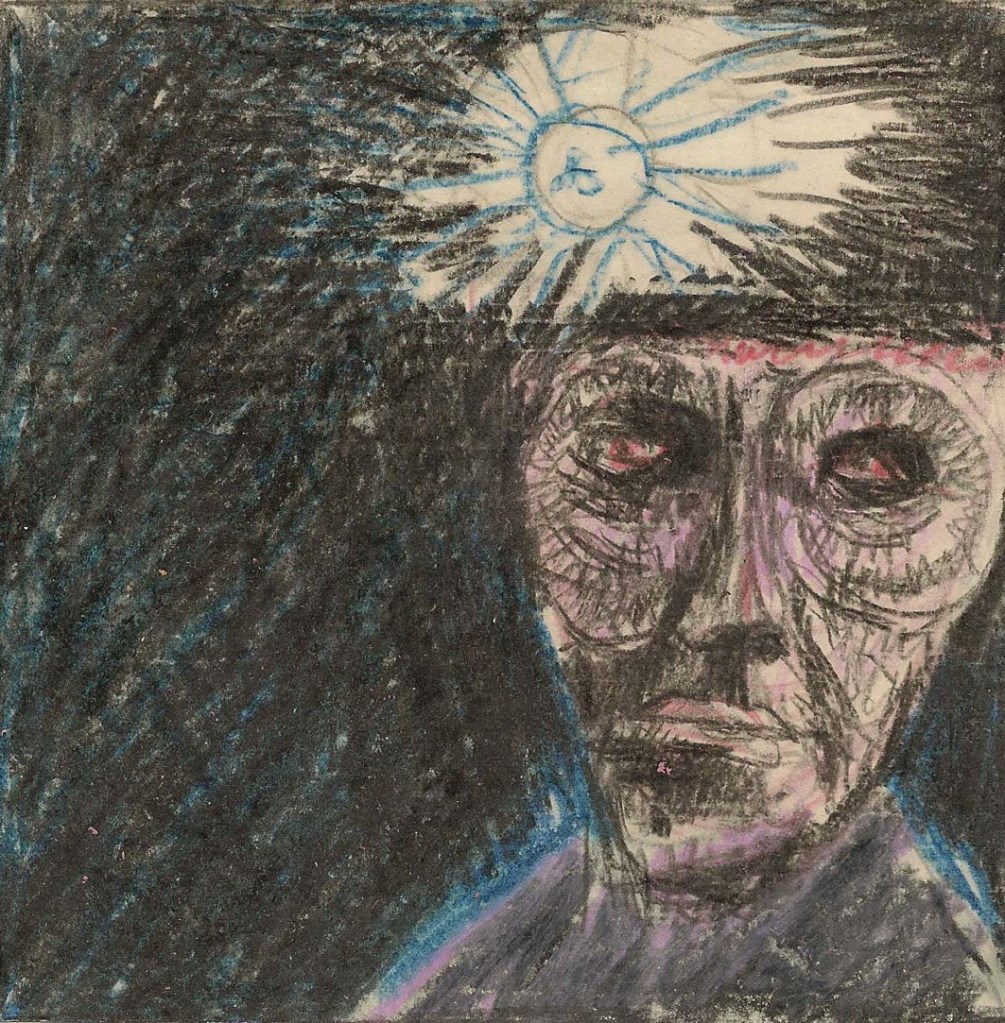
1982 Yacu-roccu-yu-roc — coloured pencil on paper; image of Carl in Japanese coal mine; his prisoner number was 166, the meaning of the title in Japanese.
September 1945 – December 1947 After Japanese capitulation, and about two and a half months medical recuperation in Manilla, Carl was made to return to active service (in violation of Geneva Convention on Prisoners of War) due to uprisings in Netherlands East Indies: served at Balikpapan on Borneo, and at Staff General Headquarters, in Batavia (Jakarta). Released from service in the rank of Sergeant. His mother and sister had been kept in civilian camps during the occupation and made to work in the fields. His mother died of her deprivations just before the end of the war. His older brother and immediately younger brother had also been called to active duty just before the Japanese invasion and as prisoners of war had laboured on the Burma railway that is the focus of the book and film, The Bridge on the River Kwai; his older brother died around the time of liberation. The fourth brother was too young to serve and was imprisoned for the duration of the war.
February 1948 – February 1949. Carl on leave in the Netherlands, where he was finally demobilized.
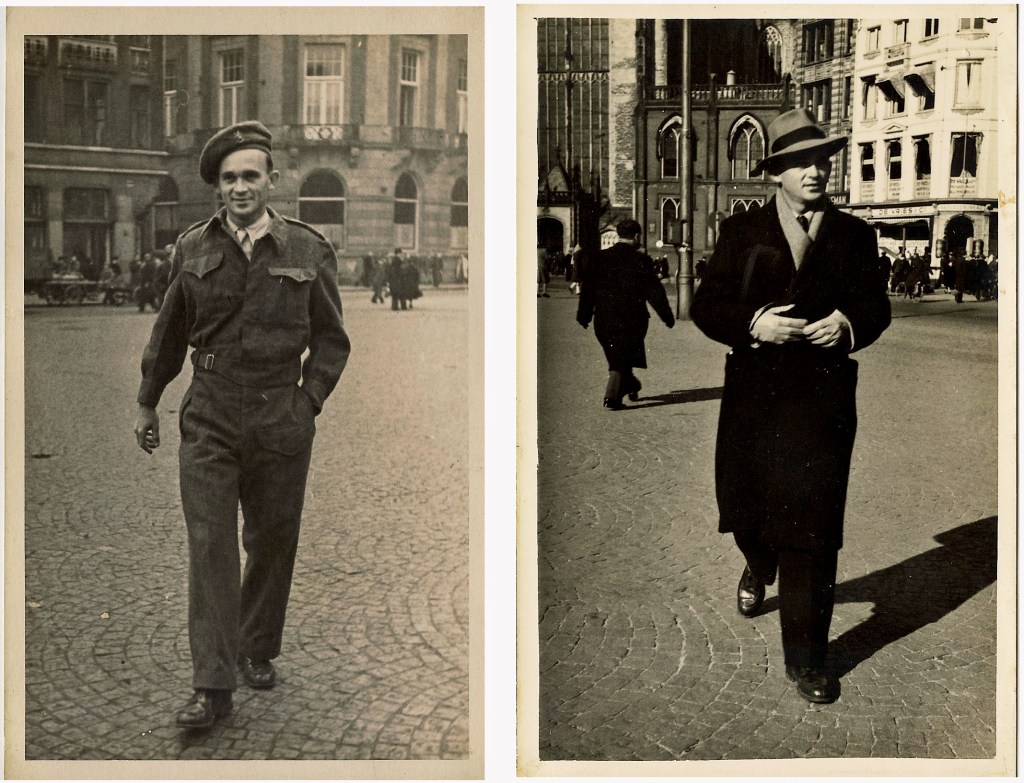
1948 — Carl on Amsterdam’s Dam Square, pictures taken about a week apart, before and after demobilization.
On June 28, 1948, Carl van den Bosch and Johanna Cornelia Klaassen (Honey) were married in Amsterdam. Carl returned to Indonesia at the end of his leave. Son Peter Nico was born in October 1949 and soon afterward Honey sets out for the Far East with infant to rejoin Carl.
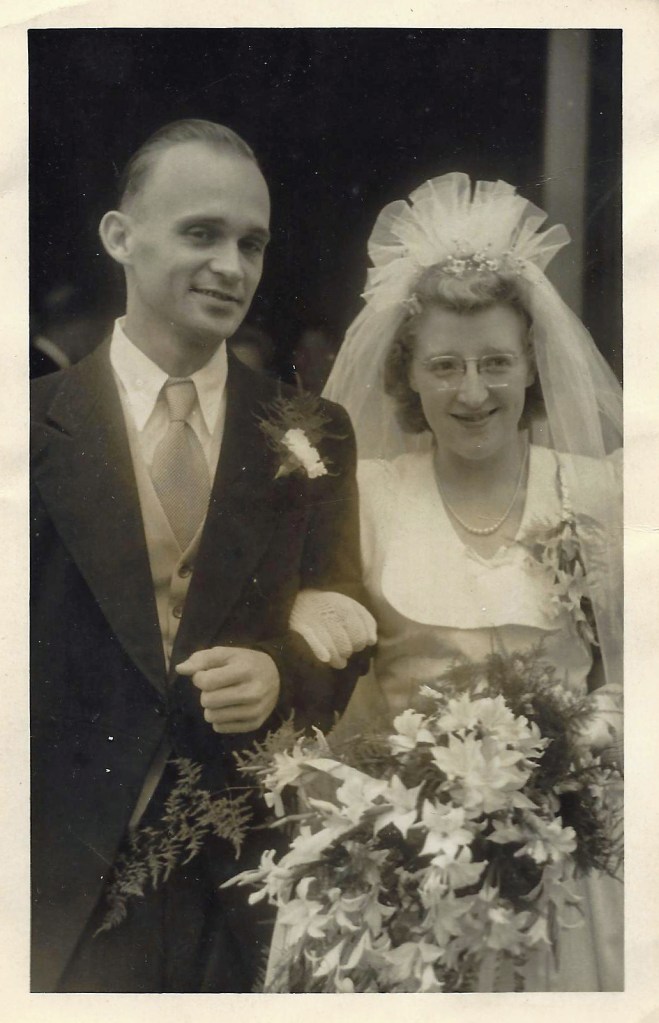
March 1949 – June 1951 Carl worked at J.A.Wattie rubber estate Kali Duren in East Java. Encouraged by Honey, he made a few water colours with supplies she bought for him. Due to continued unrest, especially in rural areas, Carl sent Honey and Peter back to Netherlands in 1950, and later resigned to join them.
June 1952 – May 1957 Worked for C. Kersten & Co. in Suriname, as branch manager in Nickerie, and at headquarters in Paramaribo. Kersten sold general merchandise, all imported. Nickerie is situated in a region of West Suriname that was home to several experimental polders intended to bring stable agriculture, primarily rice, to the region, so the main products sold at the branch were agricultural equipment, like tractors. Carl took up 8mm filmmaking with a solidly built Agfa cassette movie camera. At the request of a sales representative for one of the North American agricultural equipment manufacturers Carl made a film of the problems encountered in the polders turning the extremely dense clay soils as well as the tendency for tractors to become mired. During this time Honey once more encouraged Carl to take up painting, this time in oils.
June 1957 – April 1958 Carl worked for Caribe Unie Limitada of Bogota, Colombia, an import/export company. Due to political instability, the company was unable to sustain its work force and Carl was laid off.
May 1958 – May 1960 Carl worked various jobs in Amsterdam.
May 1960 The family emigrated to Canada. Carl’s first job, with International Harvester, took them to Chatham, in southern Ontario, where he worked as salesman. Carl started a correspondence course in cartooning. When he was laid off, the family moved to London, Ontario in October 1961. He eventually found work as hospital orderly and trained as Psychiatric Nurse. In his spare time he took a correspondence course in commercial art and returned to painting.
Summer 1964 – Carl working on Indonesian Shore: Fishing Boats in the dining area of the family apartment.
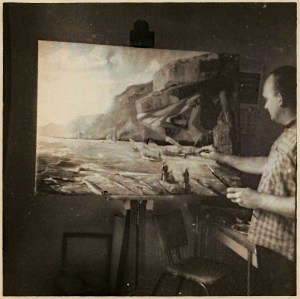
June 1968 Family moved to Vancouver, B.C. and Carl found work at Vancouver General Hospital. He took evening courses in graphic art; experimented with techniques in serigraphy; opened a studio on Broadway, near the hospital, where he spent a few hours each day. He found several galleries in Greater Vancouver, Victoria, Tacoma WA, and Portland OR that regularly sold his work. Some of these galleries would fail, and creditors seized works that the gallery held on consignment as partial payment. During the best years, the sales covered the cost of rent on the studio and materials; most years it was necessary to subsidize the work; scores of his works found their way into people’s homes through these galleries.

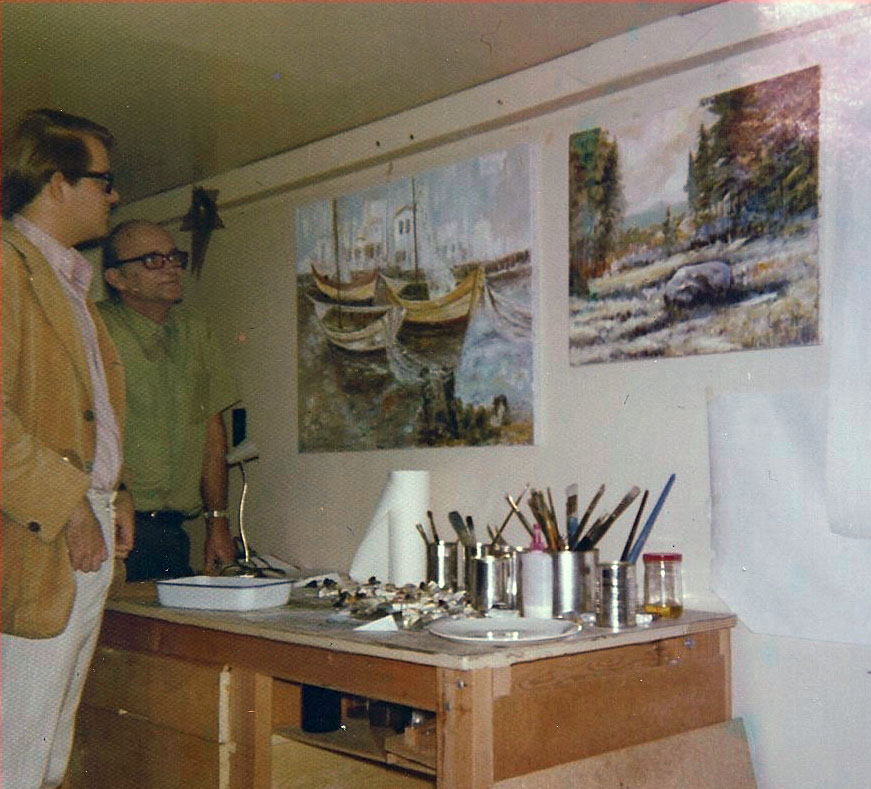
1970s – Carl showing his studio.
December 1986 The family moved to a house in south Surrey, on the Semiahmoo peninsula. Carl used facilities at the White Rock Seniors Centre and the Station Art Collective. He taught several classes at the Seniors Centre.
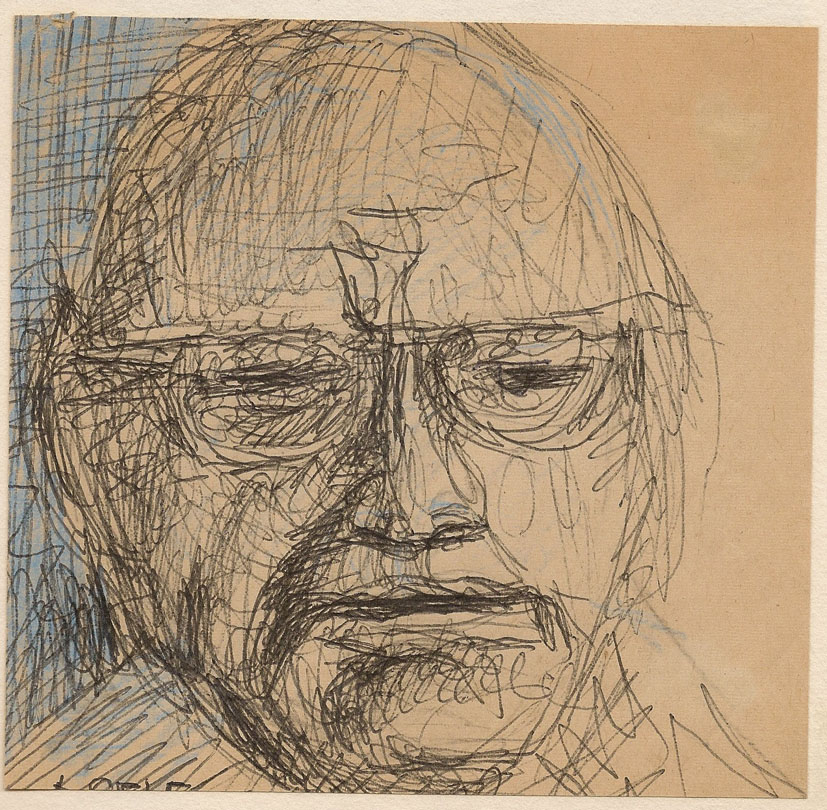
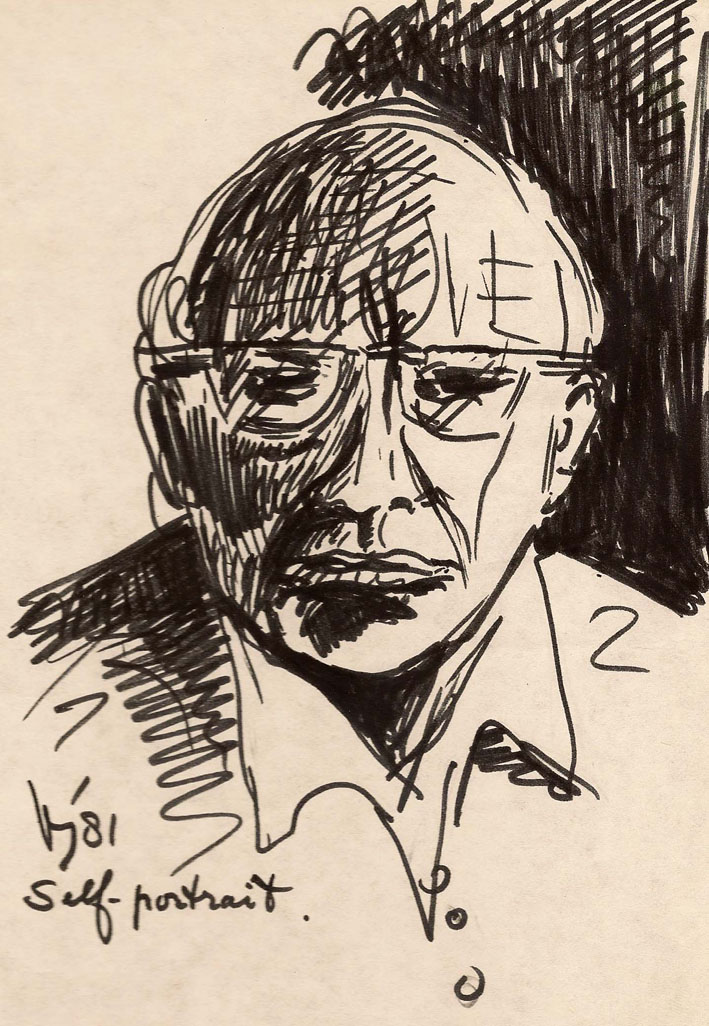
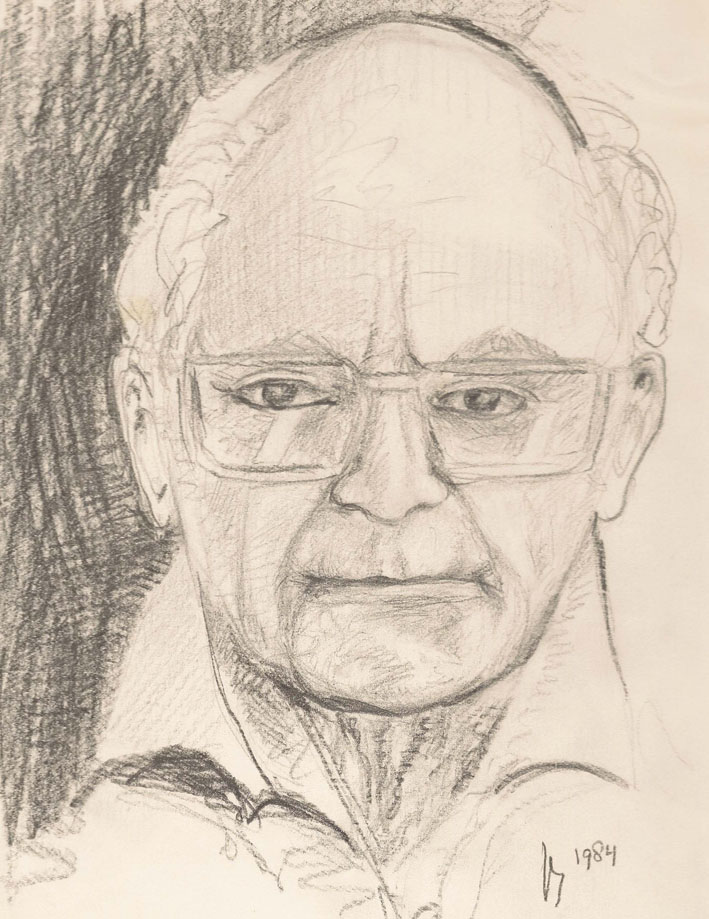
Three self portraits: 1977 ballpoint and coloured pencil; 1981 felt-tip pen; 1984 pencil.
July 4, 1993, age 74, Carl passed away in early hours at Peace Arch Hospital, White Rock, British Columbia.
Galleries
What follows is an inevitably incomplete list of art galleries that exhibited and frequently sold Carl’s work.
British Columbia
Danish Art Gallery and Gallery Ten, 3757 West Tenth Avenue, Vancouver, BC. Proprietors P. Bertelsen and A.G.(?) Bertelsen. Sold work of Carl’s 1983-1986.
Delphine’s Galleries, 3346 Cambie Street and 6347 Fraser Street, Vancouver, BC. Proprietor D. Westlake. Sold work of Carl’s 1975-77.
Downstairs Gallery, 1425 Marine Drive, West Vancouver, BC. Proprietor Renée Risten. Sold work of Carl’s, including at least one painting, 1971-77.
Images for a Canadian Heritage, 1192 Burrard Street, Vancouver, BC. Proprietor, P.H. Wall. Sold work of Carl’s 1971.
Pacific Rim Galleries Ltd., 805 West Broadway, Vancouver, BC. Proprietor G. Glendinning. Sold work of Carl’s 1975.
The Picture Show Gallery, 709 Johnson Street, Victoria, BC. Proprietor A.A. Williamson. Sold work of Carl’s 1979-80.
The Village Art Gallery, 114 Bastion Square, Victoria, BC. Proprietor A. Madding. Sold work of Carl’s 1971-72.
Washington
Gallery 1, 58 First Street, Washougal WA. Proprietor, Sandra Schwartz. Washougal is on the Columbia River, just east of Vancouver WA. Sold work of Carl’s 1973-74.
Horizon House, 111 E. 5th Avenue, Olympia WA. Proprietor J. Conant. Sold work of Carl’s 1976.
Oregon
Gemé Art Gallery, 6234 NE Glisan, Portland OR. Proprietors G.R. Will and M. Will. Sold work of Carl’s 1971.
The Paint Pot, 922 Yamhill Street, Portland OR. Proprietor B. and V.A.(?) Loewen. Sold work of Carl’s 1971-75.
Unknown Location
Gallery Six. Sold work of Carl’s 1977.
 The Art of Carl van den Bosch